

There’s a risk we need to talk about that doesn’t show up in any of my financial planning software:
We spend decades planning when we’ll have “enough” money, with far less consideration for whether the opportunities we’re saving for will still exist.
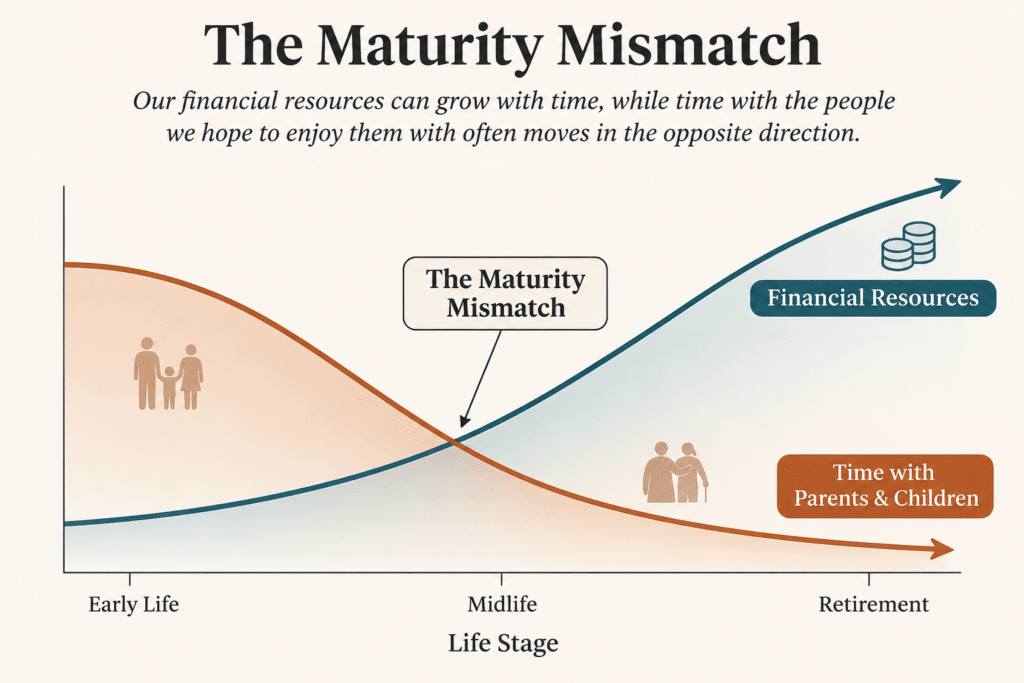
In finance, a maturity mismatch occurs when assets and obligations operate on different timelines. I think there’s a version of this in our personal lives.
Every personal finance 101 piece teaches the same core tenets:
- save early,
- invest consistently
- let compounding do the heavy lifting
Sound advice. But while wealth has the potential to grow with time, some of the opportunities move in the opposite direction.
Children grow up. Parents grow older. Our own health changes.
Estimates suggest we spend the overwhelming majority of our lifetime hours with our children before they reach adulthood. The same pattern plays out in reverse with our parents.
As a father of three young children, and two AARP-member parents, I’m living on both sides of that equation.
The Other Sequencing Risk
As a financial planner I geek-out and stress over a concept known as sequence-of-returns risk – that is, poor investment returns arriving at precisely the wrong time (the first decade of retirement being the doozy).
But there’s another sequencing risk worth considering: postponing an experience until the circumstances that made it possible have changed.
Think:
- The family vacation postponed until the kids are older.
- The trip with aging parents punted until work slows down.
- The adventure we reserve for retirement, assuming our bodies can still hang.
In Die With Zero, author Bill Perkins introduces “time buckets” – dividing life into seasons and considering which experiences belong in each.
I’d add another dimension: our most meaningful experiences often depend on other people’s time buckets overlapping with our own.
A trip with your parents depends on their health, not just yours. An adventure with your children depends on their ages and interests. The window for a multigenerational experience may be narrower still.
Can You Afford to Wait?
Financial independence creates options. But those options aren’t equally valuable at every stage of life.
As Thanksgiving approaches, consider the generations gathering around your table. Everyone shares the same afternoon, but each is experiencing it at a different point in life.
Next year’s table may look similar. Ten years from now, probably not.
We spend considerable time asking whether we can afford the things we want to do. Perhaps we should be equally interested in whether we can afford to postpone them.
After all, the question isn’t just whether an experience is worth the money. It’s whether waiting is worth the trade.