
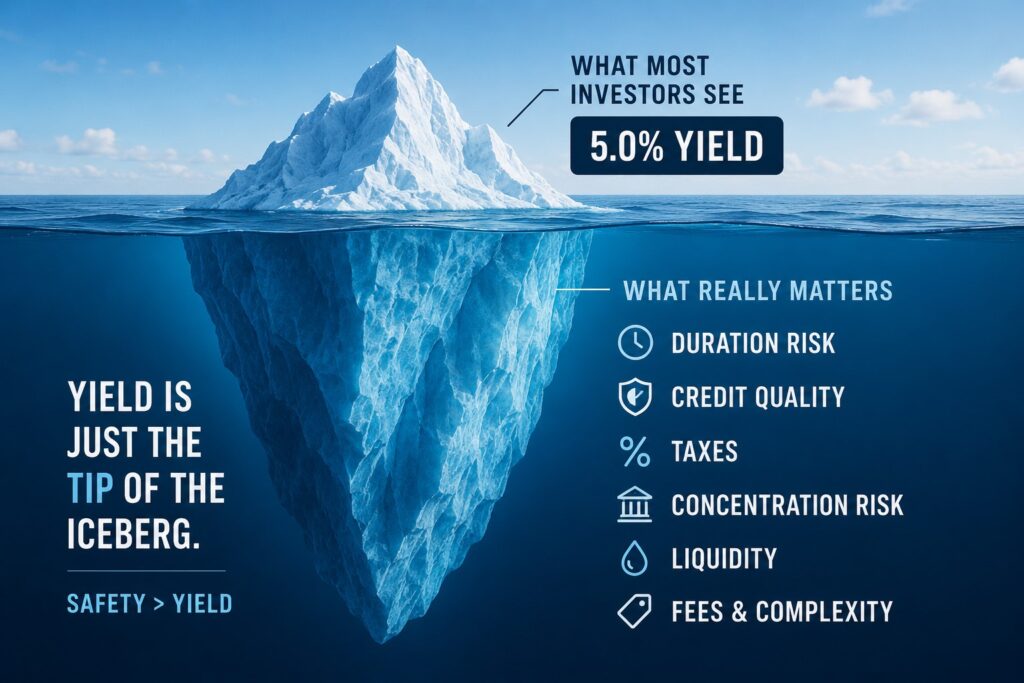
When it comes to fixed income investing, some investors prefer safety at all costs. Others want to squeeze every last bit of yield out of cash and bonds. Everywhere I look, someone is recommending a new strategy to earn another quarter of a percent. Move your money to this account. Buy this fund instead. Roll Treasury bills every few months. The underlying assumption is that higher yield automatically means a better investment.
I don’t think that’s the right way to look at it.
Yield Isn’t Free
One of the most important lessons in fixed income is that yield is simply compensation for risk. Sometimes that’s credit risk. Sometimes it’s liquidity. Sometimes it’s interest-rate risk. Markets don’t generally hand out higher yields for free. If one investment is paying materially more than another, it’s usually worth asking what risk you’re being compensated for.
The Hidden Risk in Bonds
A good example is Treasury bonds. Imagine two bonds backed by the U.S. government. One matures in three months. The other matures in thirty years. From a credit standpoint, they’re virtually identical. Yet, they have very different sensitivity to interest rate changes.
As illustrated in the image below, investors received a painful reminder of this in 2022 when long-term Treasury and investment-grade bond funds suffered some of their worst declines in decades despite having virtually no credit risk.
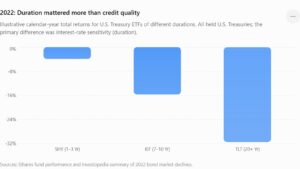
The 30-year Treasury can experience substantial price swings as interest rates change, while the 3-month Treasury remains relatively stable. That’s because longer-duration bonds are far more sensitive to changes in interest rates.
The lesson is simple: not all “safe” bonds behave safely.
Safety > Yield
This is why we tend to think about bonds differently than many investors. Rather than asking how much yield we can squeeze out of a fixed income allocation, we first ask what job those dollars are supposed to perform.
For many of our clients, bonds aren’t expected to generate eye-popping returns. Their purpose is to provide stability, liquidity, and cash flow.
That often leads us to favor higher credit quality over higher yield and, depending on the client’s needs, shorter-duration bonds over longer ones. We’d rather accept a little less income than expose money earmarked for stability to unnecessary volatility.
Headline Yield Can Be Misleading
Yield isn’t just about risk. It’s also about taxes.
Take the Vanguard New Jersey Long-Term Tax-Exempt Fund (ticker: VNJTX) as an example. For a high-income New Jersey investor, its tax-exempt income can make the yield look especially attractive on an after-tax basis. But that’s only part of the story. The fund has an average duration of roughly seven years, making it meaningfully more sensitive to changes in interest rates than a short-term bond fund or Treasury bills. It also concentrates its holdings in New Jersey municipal issuers. The tax benefit may be compelling, but it doesn’t eliminate duration or concentration risk. The stated yield rarely tells the whole story.
Beyond “T-Bill and Chill”
I recently saw an advisor publicly admonishing high yield savings accounts and instead recommending the strategy of “T-bill and chill.” On the one hand, I get it. Treasury bills are backed by the U.S. government, currently offer attractive yields, and are an excellent place for many investors to hold cash.
But they’re not automatically the right answer for everyone.
For many households, a high-yield savings account is simply more practical. Yes, the bank earns a spread between what it pays depositors and what it earns on those deposits. That’s the business model. In return, you get immediate liquidity, automatic transfers, FDIC insurance (within applicable limits), and no need to monitor maturity dates or continually reinvest proceeds.
Sometimes paying a small convenience premium is entirely rational because simplicity has value.
That said, for investors who like the idea of “T-bill and chill” but don’t want to manage rolling maturities themselves, short Treasury ETFs like SGOV offer another option. They maintain exposure to very short-term (0-3mth) Treasury bills while handling the reinvestment automatically. Like anything else, they’re not “better,” just another tool depending on what job the money is meant to do.
The Better Question
I don’t believe the goal is to maximize yield. The goal is to use each dollar in the way that best supports your financial life.
If an extra half-percent of yield requires taking significantly more credit risk, more duration risk, or more complexity than necessary, you may have optimized the wrong variable.
The better question isn’t, “How can I earn a little more?”
It’s, “What job is this money supposed to do?”
Once you answer that question, the right investment often becomes much clearer.