
Fifty years ago, Roger Ibbotson and Rex Sinquefield published research that would eventually become Stocks, Bonds, Bills, and Inflation (SBBI) – one of the foundational datasets for understanding long-term investment returns.
To mark the anniversary, CFA Institute recently published a massive update and expansion of that work:
Exponential Wealth: Centuries of Stock and Bond Returns
Nearly 400 pages. More than 200 years of market history.
Perhaps something to pickup after you finish Theo of Golden (a book that has now been recommended to me 3x and officially added to my queue).
If I could boil this CFA report down to its key point, it’s this:
History is incredibly useful for understanding what can happen.
It’s much less useful for telling us what will happen next.
For example, most of us have lived our entire investing lives with a seemingly obvious truth: stocks outperform bonds over the long run.
And over the past century, they certainly have.
During the 1900s, U.S. stocks beat government bonds by more than 5% per year.
But stretch the history back another hundred years and things get weird.
Depending on the dataset, the U.S. equity premium during the entire 1800s was somewhere between slightly negative and just 1.6% per year.
The authors believe the true number was probably positive, but still nowhere close to what investors experienced during the 1900s.
Even from 2000–2025, despite the incredible bull market of the past 15+ years, the realized equity-over-bond premium has been only about 3% per year.
Change the window of time you look at, and you can change the lesson entirely.
Which brings us to today.
It feels like we’re hitting all-time highs every other Tuesday and there’s no shortage of “experts” explaining why stocks are frothy, overpriced, or destined to deliver disappointing returns from here.
For someone who has already accumulated enough to become financially independent, the temptation is understandable:
Why keep taking the risk with equities?
Why not get more conservative, load up on bonds (yielding solid rates right now!), and call it a day?
Well, because while bonds may minimize overall portfolio volatility, volatility isn’t the only risk.
Someone retiring at 60 typically needs a portfolio that can support them for multiple decades.
During those decades:
- Groceries get more expensive.
- Property taxes rise.
- Healthcare costs change.
- Spending evolves.
Inflation doesn’t care that you don’t like market volatility.
Which leads me to my favorite chart in the report.
After factoring in inflation, from 1900 through 2025,
- $1 invested in U.S. equities grew to roughly $3,296
- $1 invested in bonds grew to about $7.50
- $1 invested in Treasury bills grew to about $1.80
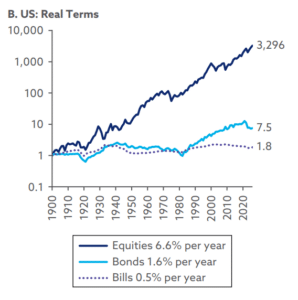
(Exhibit 11. 1, pg. 218 of PDF)
Now, before we tattoo $1 → $3,296 on our forearms, there’s an important caveat.
The authors themselves warn against blindly extrapolating America’s extraordinary past into the future. The United States emerged over this period as the world’s dominant economic power. Looking backward from today’s vantage point means we’re studying one of history’s great winners.
The chart isn’t a forecast. It illustrates why growth matters.
OUR APPROACH
At wHealth, when someone flips the page to financial independence, we generally want 7–10 years of anticipated spending needs supported by predictable income, typically in the form of high-credit-quality bonds.
In practice, this often looks like multi-year bond ladders constructed with target-dated Treasuries and investment-grade bond ETFs.
Doing this gives us the ability to weather corrections, recessions, and other periods of uncertainty without needing to sell stocks when things are down bad.
Equities, on the other hand, have one job:
GROWTH.
We maintain a sizable, globally diversified equity position in the portfolios we manage not because we know what they’ll return next year.
Nor because we think the market is a “buy” right now.
But because financial independence isn’t the finish line.
Inflation compounds. Spending compounds. Your wealth needs the opportunity to compound, too.
Two hundred years of market history can’t tell us what happens next.
That’s precisely why we build portfolios that don’t require us to know.
Enough stability to weather the storms + enough growth to fund the road ahead.