
I still remember when Hurricane Sandy hit the Jersey Shore back in 2012.
We lost power for roughly 10 days. Gas stations had lines stretching down the road. Supermarket shelves were picked clean. Ordinary conveniences disappeared.
I distinctly remember thinking, Why the hell don’t we have a generator?!
It was one of those moments when you came face-to-face with the fragility of systems you rely on.
Fast-forward 14 years, and a different set of vulnerabilities has me revisiting that feeling.
Just last week, AI-assisted researchers uncovered serious security flaws in PHP, software used to power much of the internet. The vulnerabilities were significant enough that government websites were temporarily taken offline while emergency patches were deployed.
Meanwhile, Microsoft reported that a state-linked hacking group had used autonomous AI tools to target hundreds of organizations, in some cases gaining privileged access to cloud systems in less than three hours.
It has me thinking: As our world becomes more technologically sophisticated and interconnected, there are also new points of vulnerability.
I’m by no means a cybersecurity expert and, besides some backup batteries, a case of drinking water, and some old MREs, I’m lacking in my doomsday preparedness.
But these recent events have forced the mental exercise of thinking more seriously about how prepared my own family would be if the systems we rely upon were suddenly unavailable.
The Secure Plan
In financial planning, I find it helpful to think about three different plans:
- The Secure Plan: What do we need to protect ourselves and our families from meaningful disruptions?
- The Comfortable Plan: What resources would allow us to enjoy the lifestyle we envision?
- The Wealthy Plan: What would financial abundance and opportunity look like if things went exceptionally well?
Naturally, we spend a lot of time dreaming about the latter two.
But perhaps we should index some of our time, energy, and resources toward the first.
Just as we assess risk tolerance and risk capacity when constructing an investment portfolio, I think there’s a similar exercise worth undertaking with our personal preparedness.
How much disruption could your household comfortably absorb? How much inconvenience are you willing to tolerate? How much time and money are you willing to dedicate to protecting against events that may never occur?
I don’t think there’s one right answer. And I certainly haven’t figured out the right answer for my own family.
A Little Prepper 101
Here are some practical considerations I’ve been revisiting, ranging from simple precautions to more substantial investments in resilience.
Digital and financial security
- A password manager (I use 1Password) with unique passwords, passkeys, and two-factor authentication.
- Credit freezes with all three bureaus and an IRS Identity Protection PIN.
- Automatic software updates + additional protection against SIM swapping.
- A secure inventory of financial accounts, insurance policies, and important documents that a spouse or trusted person can access.
Basic household preparedness
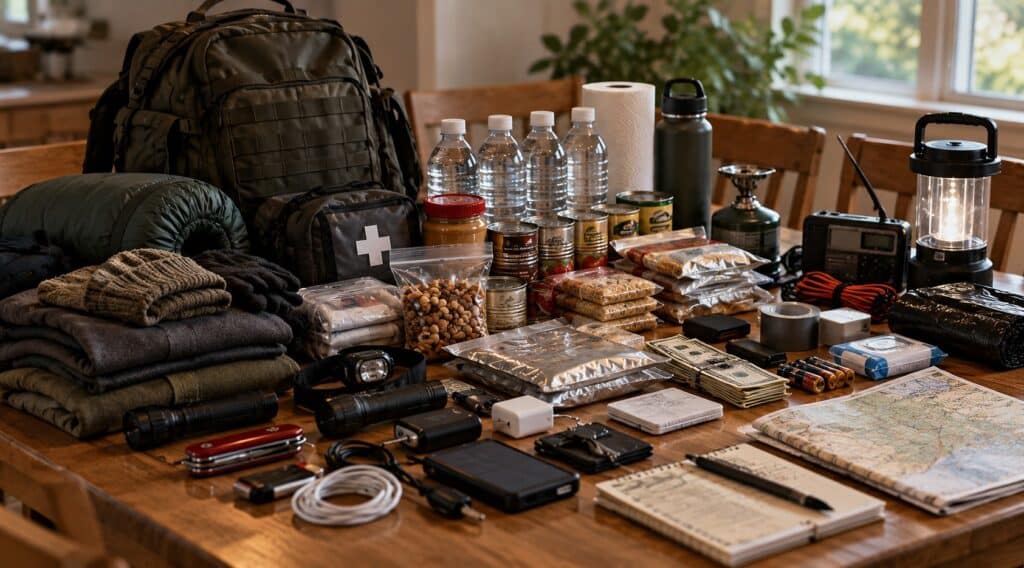
- Several days of drinking water, shelf-stable food, and necessary medications.
- Flashlights, batteries, first-aid supplies, and portable charging banks.
- Some physical cash in case ATMs or electronic payment systems are unavailable.
- A printed list of important contacts, account institutions, and emergency information.
Going a step further
- A generator or backup battery system for essential appliances.
- A reserve of fuel (stored safely and in accordance with local regulations).
- A backup internet or communication option.
- A family emergency plan, including where to meet and how to communicate if cellular networks are disrupted.
Admittedly, none of these ideas are revolutionary. Many are relatively inexpensive. Others require more meaningful investments.
And that’s where the risk-tolerance analogy becomes useful.
For some families, a few days of supplies and basic digital protections may be sufficient. Others might reasonably want to prepare for a week or two without electricity, banking access, or reliable communications.
The objective isn’t necessarily to prepare for the apocalypse. It’s to identify the disruptions that would most meaningfully affect your family and consider whether some modest preparation today could make tomorrow considerably less stressful.
Diversification Beyond Your Portfolio
We diversify investments to hedge against the unknown future.
We purchase insurance to protect downside risk.
We maintain emergency funds because life throws curveballs.
Perhaps our Secure Plan deserves the same thoughtful approach.
I haven’t arrived at any grand conclusions, just more conscious of how much of our everyday comfort depends on systems functioning exactly as expected.
And remembering Hurricane Sandy, I know firsthand that sometimes they don’t.
The point isn’t to spend our lives worrying about everything that could go wrong. It’s to build enough resilience that we can spend more of our lives enjoying everything that could go right.
Hope for the best. Prepare for the worst. And keep living fully in the meantime.