

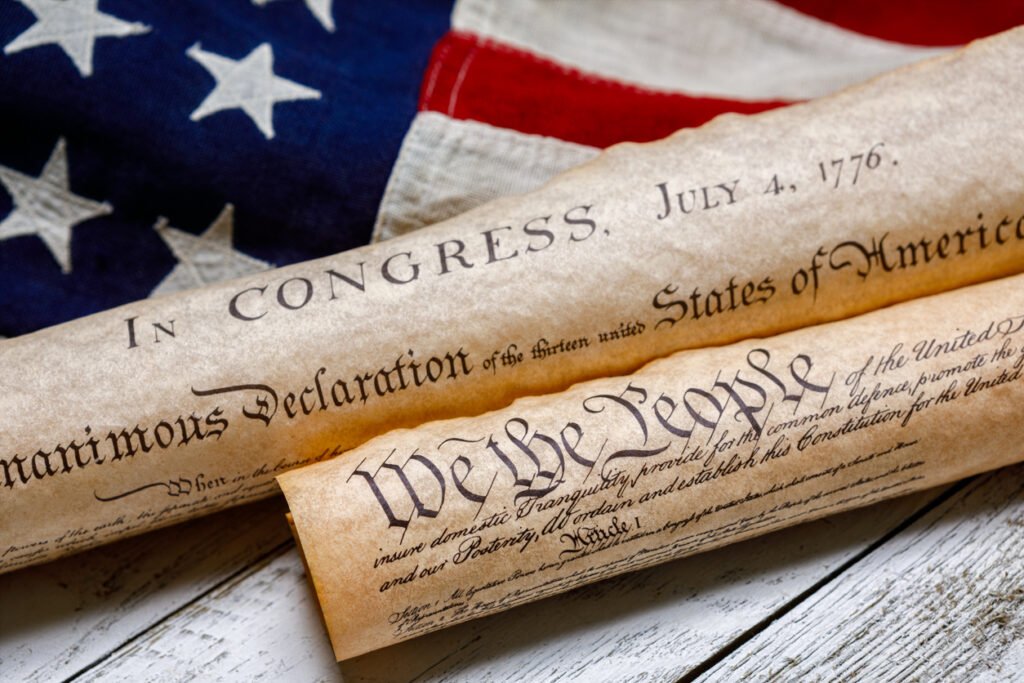
As a financial planner, I spend a lot of time thinking about taxes.
So heading into the Fourth of July, I figured I’d be writing about…well…taxes.
Instead, Walter Isaacson sent me down a rabbit hole.
I recently listened to him discuss his book, The Greatest Sentence Ever Written, during a conversation with Shilo Brooks on the Old School podcast. The book is entirely about the second sentence of the Declaration of Independence.
Naturally, I was intrigued.
Jefferson’s Real Genius
What I didn’t expect was learning that Thomas Jefferson never intended the Declaration to be an original work of political philosophy. Nearly fifty years after writing it, Jefferson reflected that he was “neither aiming at originality of principle or sentiment.”
What made it so extraordinary then? The answer begins with the Enlightenment.
Jefferson wasn’t inventing a new philosophy. He was synthesizing one.
The Declaration distilled ideas that had emerged during the Enlightenment, were refined by thinkers like John Locke, and were popularized in America through Thomas Paine’s Common Sense.
Jefferson’s genius wasn’t creating those ideas – it was expressing them with extraordinary clarity.
Locke’s Influence
If the Enlightenment had social media, Locke would’ve been dropping threads…and Jefferson would’ve been bookmarking every one of them.
I first encountered Locke in one of my favorite classes at Rutgers: History of Economic Thought.
At the time, I thought I was studying economics. It’s now clear I was also studying the intellectual foundations of the American experiment.
And that’s where this unexpectedly connects back to financial planning – because Locke helped establish a simple but profound idea:
the rules that govern our money are downstream of the ideas that govern our society.
Think:
- Property rights.
- Contracts.
- Capital markets.
- Entrepreneurship.
- Taxes.
None of these exists in isolation. They’re products of a much larger framework built on the rule of law rather than arbitrary power.
Franklin’s Embodiment
Benjamin Franklin may be the perfect embodiment of what that framework made possible.
Just think about the résumé for a second:
Printer. Entrepreneur. Inventor. Scientist. Diplomat. Investor.
(I’ve always had a soft spot for Franklin. Maybe it’s because I’ve never been very good at staying in one intellectual lane. It’s probably why an economics class, a history podcast, and the IRS tax code all somehow connect in my brain  .)
.)
Franklin wasn’t remarkable because he fit neatly into one profession. He was remarkable because he didn’t have to.
He lived in a society that increasingly rewarded curiosity, experimentation, enterprise, voluntary exchange, and the freedom to build.
Why This Still Matters
Franklin wasn’t the exception. He became the template.
Over the next 250 years, millions of others would follow: founders, inventors, scientists, investors, and entrepreneurs pushing the frontier of what was possible.
America’s story has never been one of perfection. It has, however, been one of extraordinary progress, building institutions where free people could create, invest, innovate, and pursue opportunity under the rule of law.
So where do taxes fit into all of this?
Ironically, they were never the point.
The Founders weren’t fighting for a country without taxes.
They were fighting for a country governed by law rather than arbitrary power.
Final Thoughts
As a financial planner, I don’t spend much time debating what the tax code should be.
My responsibility is understanding the one that exists and helping families legally and thoughtfully navigate it – not to “beat the system,” but to use the system exactly as it was written.
On the surface, it’s investments, taxes, and retirement.
Underneath, it’s understanding the systems we live within.
The deeper I dig into subjects that seem unrelated (i.e. history, economics, psychology, technology etc.) the more I realize they’re not unrelated at all.
The more I learn, the better questions I ask, the better decisions I make, and hopefully, the better advice I give  .
.
Happy Fourth!