
Yield-Maxxing

When it comes to fixed income investing, some investors prefer safety at all costs. Others want to squeeze every last bit of yield out of cash and bonds. Everywhere I look, someone is recommending a new strategy to earn another quarter of a percent. Move your money to this account. Buy this fund instead. Roll Treasury bills every few months. The underlying assumption is that higher yield automatically means a better investment.

I don’t think that’s the right way to look at it.

Yield Isn’t Free

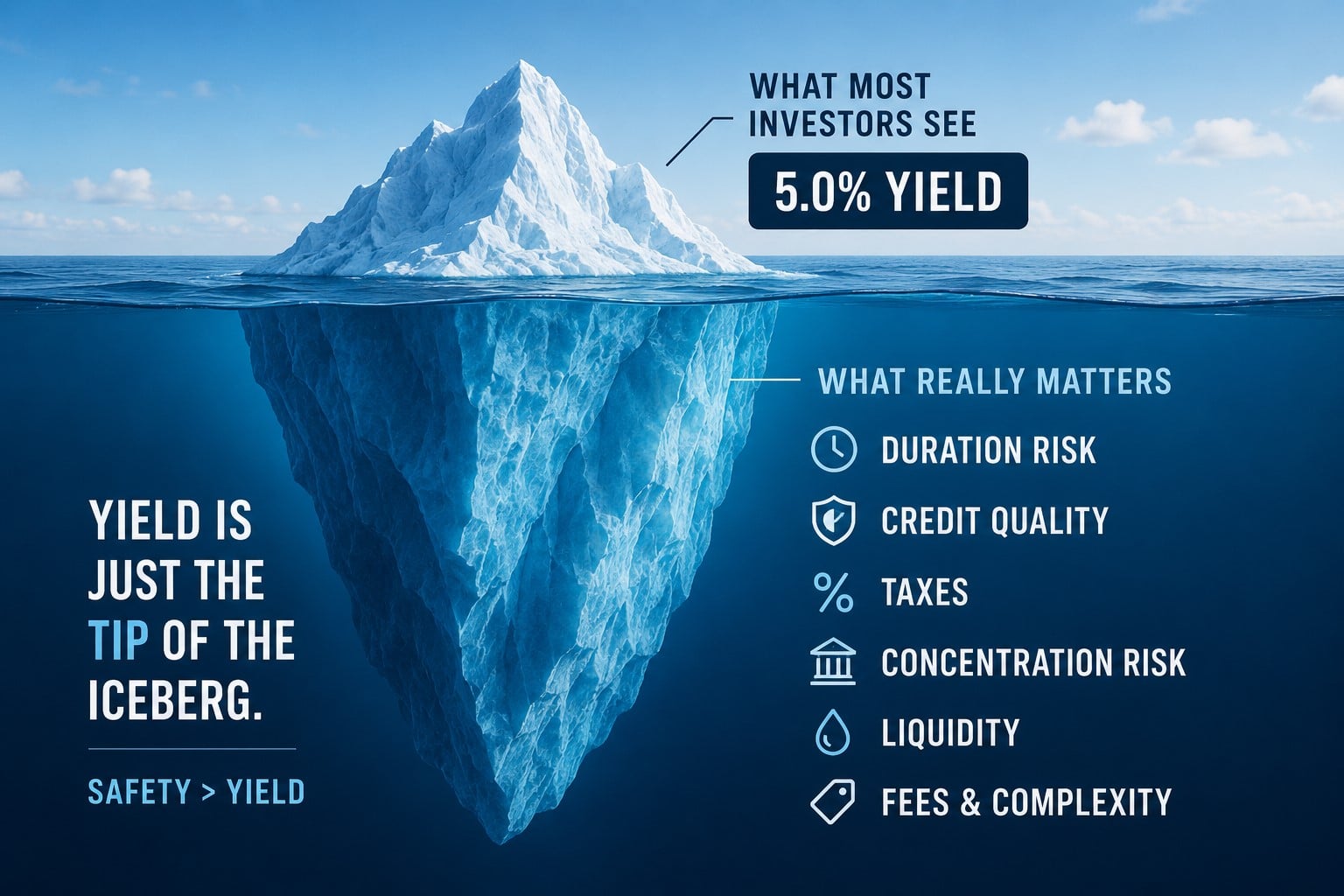
One of the most important lessons in fixed income is that yield is simply compensation for risk. Sometimes that’s credit risk. Sometimes it’s liquidity. Sometimes it’s interest-rate risk. Markets don’t generally hand out higher yields for free. If one investment is paying materially more than another, it’s usually worth asking what risk you’re being compensated for.

The Hidden Risk in Bonds

A good example is Treasury bonds. Imagine two bonds backed by the U.S. government. One matures in three months. The other matures in thirty years. From a credit standpoint, they’re virtually identical. Yet, they have very different sensitivity to interest rate changes.

As illustrated in the image below, investors received a painful reminder of this in 2022 when long-term Treasury and investment-grade bond funds suffered some of their worst declines in decades despite having virtually no credit risk.
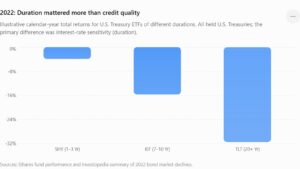
The 30-year Treasury can experience substantial price swings as interest rates change, while the 3-month Treasury remains relatively stable. That’s because longer-duration bonds are far more sensitive to changes in interest rates.

The lesson is simple: not all “safe” bonds behave safely.

Safety > Yield

This is why we tend to think about bonds differently than many investors. Rather than asking how much yield we can squeeze out of a fixed income allocation, we first ask what job those dollars are supposed to perform.

For many of our clients, bonds aren’t expected to generate eye-popping returns. Their purpose is to provide stability, liquidity, and cash flow.

That often leads us to favor higher credit quality over higher yield and, depending on the client’s needs, shorter-duration bonds over longer ones. We’d rather accept a little less income than expose money earmarked for stability to unnecessary volatility.

Headline Yield Can Be Misleading

Yield isn’t just about risk. It’s also about taxes.

Take the Vanguard New Jersey Long-Term Tax-Exempt Fund (ticker: VNJTX) as an example. For a high-income New Jersey investor, its tax-exempt income can make the yield look especially attractive on an after-tax basis. But that’s only part of the story. The fund has an average duration of roughly seven years, making it meaningfully more sensitive to changes in interest rates than a short-term bond fund or Treasury bills. It also concentrates its holdings in New Jersey municipal issuers. The tax benefit may be compelling, but it doesn’t eliminate duration or concentration risk. The stated yield rarely tells the whole story.

Beyond “T-Bill and Chill”

I recently saw an advisor publicly admonishing high yield savings accounts and instead recommending the strategy of “T-bill and chill.” On the one hand, I get it. Treasury bills are backed by the U.S. government, currently offer attractive yields, and are an excellent place for many investors to hold cash.

But they’re not automatically the right answer for everyone.

For many households, a high-yield savings account is simply more practical. Yes, the bank earns a spread between what it pays depositors and what it earns on those deposits. That’s the business model. In return, you get immediate liquidity, automatic transfers, FDIC insurance (within applicable limits), and no need to monitor maturity dates or continually reinvest proceeds.

Sometimes paying a small convenience premium is entirely rational because simplicity has value.

That said, for investors who like the idea of “T-bill and chill” but don’t want to manage rolling maturities themselves, short Treasury ETFs like SGOV offer another option. They maintain exposure to very short-term (0-3mth) Treasury bills while handling the reinvestment automatically. Like anything else, they’re not “better,” just another tool depending on what job the money is meant to do.

The Better Question

I don’t believe the goal is to maximize yield. The goal is to use each dollar in the way that best supports your financial life.

If an extra half-percent of yield requires taking significantly more credit risk, more duration risk, or more complexity than necessary, you may have optimized the wrong variable.

The better question isn’t, “How can I earn a little more?”

It’s, “What job is this money supposed to do?”

Once you answer that question, the right investment often becomes much clearer.

The Social Security Decision Isn’t About Social Security

With one piece of critical information, I can tell you exactly when to claim your Social Security.

Ok… ready?

When will you (and, if married, your spouse) die?

Tricky, huh?

That’s what makes Social Security one of the most misunderstood decisions in financial planning. People desperately want a simple answer:

“Should I take it at 62, full retirement age, or wait until 70?”

I’ve become convinced that’s the wrong question. The real question is:

How does Social Security fit into your family’s broader financial plan?

The “Break-Even” Trap

One of the first calculations people make is the break-even analysis.

If I delay until 70 instead of claiming earlier, how old do I have to live before I come out ahead?”

It’s a reasonable question. After all, for every year you delay claiming after your Full Retirement Age, your benefit permanently increases by roughly 8% until age 70.

That sounds like an incredible deal.

But it’s not free.

Every year you delay is also a year you’re giving up a year’s worth of Social Security checks.

Depending on the ages being compared and assumptions used, the math often works out such that you need to live into your early 80s – roughly age 82 to 84 – before the higher monthly benefit overtakes the years of payments you skipped.

That’s where many people stop.

They shouldn’t.

Your Social Security Decision Is Rarely Just About You

Spouses almost never have identical earnings histories. One benefit is often materially larger than the other. Which means we’re no longer trying to maximize your benefit. We’re trying to maximize the family’s.

Sometimes that means the lower-earning spouse claims earlier.

Sometimes it means delaying the higher earner’s benefit – not because they’re likely to live longer, but because they’re more likely to die first.

Yeah… that’s an uncomfortable sentence to write.

It’s also one of the most important conversations we have.

After all, the surviving spouse doesn’t continue collecting both checks. They keep the larger one.

One of Retirement’s Best Inflation Hedges

Here’s another, often overlooked, point.

Inflation can derail even the best laid retirement plans, and retirement assets don’t automatically keep pace with inflation.

Your investment portfolio might.
Your pension probably doesn’t.
Annuities often require paying extra for inflation protection – and even then, increases are frequently capped at 3%.

Social Security is different.

Each year, benefits are adjusted based on inflation through the annual Cost-of-Living Adjustment (COLA).

During the inflation surge following COVID, consumer prices rose at the fastest pace in four decades. In response, Social Security benefits increased 8.7% in 2023 – the largest cost-of-living adjustment in more than 40 years.

That’s a feature that deserves more attention than it gets.

Mortality Matters

There’s one more uncomfortable reality.

In many marriages, one spouse will outlive the other. Statistically, that’s often the wife – but every family is different.

If the higher-earning spouse dies first, the surviving spouse generally steps into the larger Social Security benefit.

That means delaying the larger benefit isn’t just increasing one person’s monthly check, it may be increasing the surviving spouse’s guaranteed, inflation-adjusted income for decades.

Suddenly, the decision isn’t about maximizing one lifetime. It’s about protecting two.

There Isn’t A Universal Right Answer

I’ve had clients with significant health issues who claimed early and never looked back.

I’ve had others delay until age 70 because they wanted the largest possible guaranteed income later in retirement.

I’ve had couples where each spouse claimed at different ages because that combination best fit their goals.

Every one of those decisions was correct.

Because every one of those families had different priorities, different health, different assets, and different risks to manage.

Good Financial Planning Lives In The Gray

The longer I practice, the less I believe financial planning is about finding perfect answers.

The goal isn’t to maximize Social Security.

The goal is to maximize the probability that your retirement works – regardless of what the future has in store.

No Taxation Without…

As a financial planner, I spend a lot of time thinking about taxes.

So heading into the Fourth of July, I figured I’d be writing about…well…taxes.

Instead, Walter Isaacson sent me down a rabbit hole.

I recently listened to him discuss his book, The Greatest Sentence Ever Written, during a conversation with Shilo Brooks on the Old School podcast. The book is entirely about the second sentence of the Declaration of Independence.

Naturally, I was intrigued.

Jefferson’s Real Genius

What I didn’t expect was learning that Thomas Jefferson never intended the Declaration to be an original work of political philosophy. Nearly fifty years after writing it, Jefferson reflected that he was “neither aiming at originality of principle or sentiment.”

What made it so extraordinary then? The answer begins with the Enlightenment.

Jefferson wasn’t inventing a new philosophy. He was synthesizing one.

The Declaration distilled ideas that had emerged during the Enlightenment, were refined by thinkers like John Locke, and were popularized in America through Thomas Paine’s Common Sense.

Jefferson’s genius wasn’t creating those ideas – it was expressing them with extraordinary clarity.

Locke’s Influence

If the Enlightenment had social media, Locke would’ve been dropping threads…and Jefferson would’ve been bookmarking every one of them.

I first encountered Locke in one of my favorite classes at Rutgers: History of Economic Thought.

At the time, I thought I was studying economics. It’s now clear I was also studying the intellectual foundations of the American experiment.

And that’s where this unexpectedly connects back to financial planning – because Locke helped establish a simple but profound idea:

the rules that govern our money are downstream of the ideas that govern our society.

Think:

  • Property rights.
  • Contracts.
  • Capital markets.
  • Entrepreneurship.
  • Taxes.

None of these exists in isolation. They’re products of a much larger framework built on the rule of law rather than arbitrary power.

Franklin’s Embodiment 

Benjamin Franklin may be the perfect embodiment of what that framework made possible.

Just think about the résumé for a second:

Printer. Entrepreneur. Inventor. Scientist. Diplomat. Investor.

(I’ve always had a soft spot for Franklin. Maybe it’s because I’ve never been very good at staying in one intellectual lane. It’s probably why an economics class, a history podcast, and the IRS tax code all somehow connect in my brain 😊.)

Franklin wasn’t remarkable because he fit neatly into one profession. He was remarkable because he didn’t have to.

He lived in a society that increasingly rewarded curiosity, experimentation, enterprise, voluntary exchange, and the freedom to build.

Why This Still Matters

Franklin wasn’t the exception. He became the template.

Over the next 250 years, millions of others would follow: founders, inventors, scientists, investors, and entrepreneurs pushing the frontier of what was possible.

America’s story has never been one of perfection. It has, however, been one of extraordinary progress, building institutions where free people could create, invest, innovate, and pursue opportunity under the rule of law.

So where do taxes fit into all of this?

Ironically, they were never the point.

The Founders weren’t fighting for a country without taxes.

They were fighting for a country governed by law rather than arbitrary power.

Final Thoughts

As a financial planner, I don’t spend much time debating what the tax code should be.

My responsibility is understanding the one that exists and helping families legally and thoughtfully navigate it – not to “beat the system,” but to use the system exactly as it was written.

On the surface, it’s investments, taxes, and retirement.

Underneath, it’s understanding the systems we live within.

The deeper I dig into subjects that seem unrelated (i.e. history, economics, psychology, technology etc.) the more I realize they’re not unrelated at all.

The more I learn, the better questions I ask, the better decisions I make, and hopefully, the better advice I give 😉.

Happy Fourth!